
A Comprehensive Guide for Clinical Research Professionals
Clinical trials are the foundation of evidence-based medicine, ensuring that every new drug, vaccine, or device is safe and effective before it reaches patients. Behind every successful trial stands a team of Clinical Operations professionals, who coordinate, monitor, and document every step of the research process.
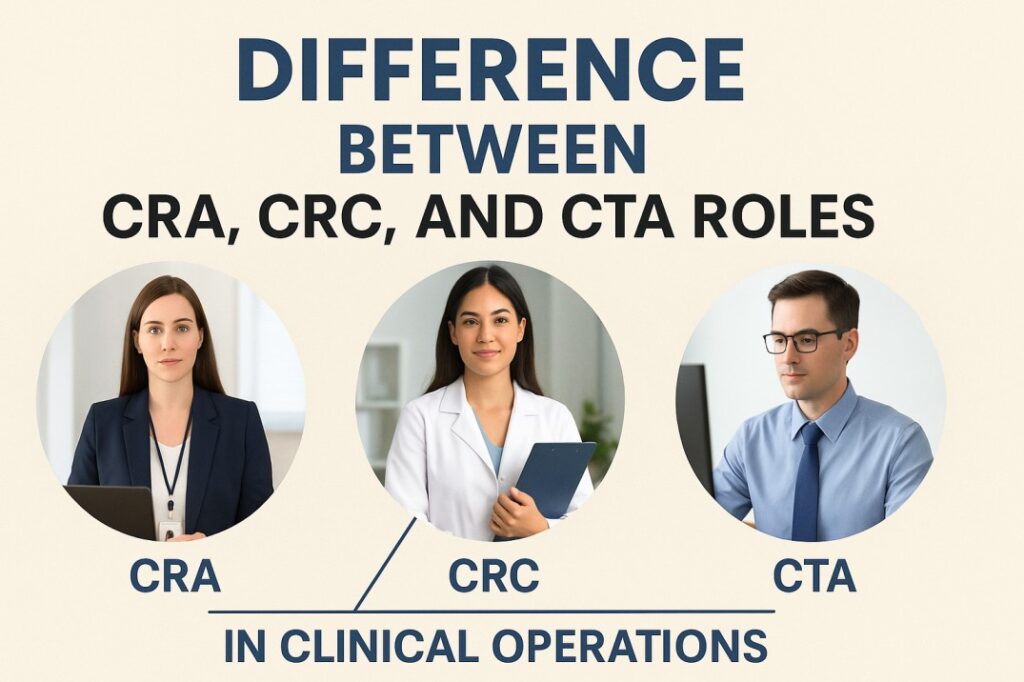
Among these professionals, three pivotal roles are Clinical Research Associate (CRA), Clinical Research Coordinator (CRC), and Clinical Trial Assistant (CTA). Although their responsibilities may appear overlapping, each plays a distinct and crucial role in ensuring regulatory compliance, data integrity, and operational efficiency.
Let’s explore the roles, responsibilities, skills, and technical distinctions between CRA, CRC, and CTA in detail.
Clinical Research Associate (CRA)
Overview
A Clinical Research Associate (CRA) acts as a field-based monitor representing the sponsor or Contract Research Organization (CRO). The CRA ensures that the study is conducted in accordance with the protocol, ICH-GCP (E6 R2) guidelines, SOPs, and local regulatory requirements.
They serve as the primary link between the sponsor and the investigator site, responsible for the quality and accuracy of trial data and overall site performance.
Core Responsibilities
Site Qualification and Initiation: Conducting Site Qualification Visits (SQVs) to assess site feasibility and Site Initiation Visits (SIVs) to train the site staff on the protocol, CRF completion, and regulatory requirements.
Monitoring Visits: Performing Remote Monitoring (RMV) and On-site Monitoring Visits (IMV) to ensure data consistency between source documents and Case Report Forms (CRFs/eCRFs).
Source Data Verification (SDV): Verifying that data entered into the eCRF matches the subject’s medical records and source notes.
Protocol Compliance: Identifying and documenting protocol deviations or violations and ensuring corrective actions.
Safety Reporting: Reviewing Serious Adverse Event (SAE) documentation, ensuring timelines and reporting requirements are met.
Regulatory and Ethics Compliance: Ensuring that IRB/IEC approvals, informed consent forms (ICFs), and essential documents are in place and updated.
Monitoring Reports: Preparing detailed Monitoring Visit Reports (MVRs) for each visit, summarizing findings and action items.
Technical Skills Required
In-depth understanding of ICH-GCP, 21 CFR Part 312/812, Schedule Y, and Declaration of Helsinki.
Proficiency in EDC (Electronic Data Capture) systems like Medidata Rave, Oracle Clinical, or Veeva.
Knowledge of Risk-Based Monitoring (RBM) approaches and Quality Tolerance Limits (QTLs).
Strong interpersonal communication for coordinating with Investigators, CRCs, and Project Managers.
Excellent reporting, analytical, and time-management abilities.
Typical Career Path
CTA → Junior CRA → CRA → Senior CRA → Lead CRA → Clinical Project Manager (CPM)
Clinical Research Coordinator (CRC)
Overview
A Clinical Research Coordinator (CRC) is a site-based professional, usually working under the supervision of the Principal Investigator (PI) at a hospital, academic institution, or private research site.
The CRC ensures the execution of the clinical protocol at the site level — coordinating patient visits, managing documents, and maintaining data accuracy.
Core Responsibilities
Subject Screening and Enrollment: Identifying eligible subjects as per the inclusion/exclusion criteria and maintaining a Screening Log.
Informed Consent Process: Ensuring subjects understand and voluntarily sign the Informed Consent Form before any study-related procedure.
Visit Coordination: Scheduling and conducting study visits, maintaining Visit Logs, and ensuring protocol-defined timelines are met.
Source Documentation: Maintaining Source Notes, Subject Files, and Study Binders as per GCP.
Investigational Product (IP) Handling: Ensuring storage, temperature logs, and dispensing of IP as per sponsor guidelines. Maintaining Drug Accountability Logs.
Data Entry and Query Resolution: Entering data into the eCRF and resolving Data Clarification Forms (DCFs) raised by CRAs or data managers.
Safety and AE Reporting: Notifying SAEs/AEs to the Ethics Committee and sponsor within regulatory timelines.
Regulatory Document Management: Keeping CVs, training logs, delegation logs, and ethics approvals updated.
Technical Skills Required
Working knowledge of clinical documentation, eCRF entry, and CTMS (Clinical Trial Management Systems).
Understanding of source data verification principles, patient confidentiality, and Good Documentation Practices (GDP).
Ability to handle protocol amendments, reconsent processes, and query resolution effectively.
Excellent communication with investigators, subjects, and monitoring CRAs.
Basic understanding of pharmacovigilance and SAE narrative preparation.
Typical Career Path
Trainee CRC → CRC → Senior CRC → Site Manager / Clinical Operations Specialist.
Clinical Trial Assistant (CTA)
Overview
A Clinical Trial Assistant (CTA) plays a supportive role to the CRA and Project Management team. CTAs are typically office-based, responsible for maintaining documentation, trackers, and communications essential for the smooth conduct of multiple studies.
This role is ideal for freshers entering the field of Clinical Research and offers strong exposure to regulatory and operational workflows.
Core Responsibilities
Trial Master File (TMF/eTMF) Management: Organizing and maintaining essential study documents in compliance with ICH-GCP E6(R2) and ALCOA+ principles.
Tracking and Document Control: Maintaining study trackers for site initiation, regulatory submissions, and monitoring visit schedules.
Communication Support: Managing email correspondence between CRAs, sites, and sponsors; scheduling teleconferences and investigator meetings.
Study Metrics and Reports: Assisting in preparing project status reports, KPIs, and risk logs.
Training Documentation: Tracking site staff CVs, GCP certificates, and delegation logs.
Audit Preparation: Assisting in TMF QC checks and preparing the study for sponsor or regulatory audits.
Technical Skills Required
Strong knowledge of Microsoft Office, Excel trackers, and document version control.
Familiarity with Veeva Vault eTMF, MasterControl, or SharePoint platforms.
Understanding of SOPs, document lifecycle, and audit trail requirements.
Good organizational, coordination, and communication skills.
Typical Career Path
CTA → Junior CRA → CRA → Senior CRA / Clinical Project Manager
Comparison Table
| Parameter | CRA | CRC | CTA |
|---|---|---|---|
| Primary Role | Monitoring and compliance | Site coordination and execution | Documentation and administrative support |
| Workplace | CRO/Sponsor (Field-based) | Investigator site (Hospital/Institute) | Sponsor/CRO Office |
| Subject Interaction | No | Yes | No |
| Key Focus | Quality, SDV, audit compliance | Patient care, data entry, documentation | File management, communication, logistics |
| Travel Requirement | High | Low | Minimal |
| System Usage | eCRF, EDC, RBM, CTMS | eCRF, CTMS, IP logs | eTMF, Excel trackers, SharePoint |
| Average Salary (India) | ₹6–10 LPA | ₹3–6 LPA | ₹2.5–4.5 LPA |
Final Summary
Each of these roles — CRA, CRC, and CTA — is an essential pillar in Clinical Operations.
The CRA ensures regulatory compliance and data integrity at multiple sites.
The CRC ensures smooth site-level execution and patient management.
The CTA ensures centralized documentation and operational coordination.
Together, they maintain the scientific validity, ethical conduct, and operational efficiency of clinical trials.
For pharmacy and life science graduates aspiring to enter clinical research, starting as a CTA or CRC provides a strong foundation. With continuous training, understanding of GCP, and technical tool exposure (CTMS, eTMF, EDC), one can easily transition into advanced roles like CRA, Clinical Project Manager, or Regulatory Affairs Specialist.