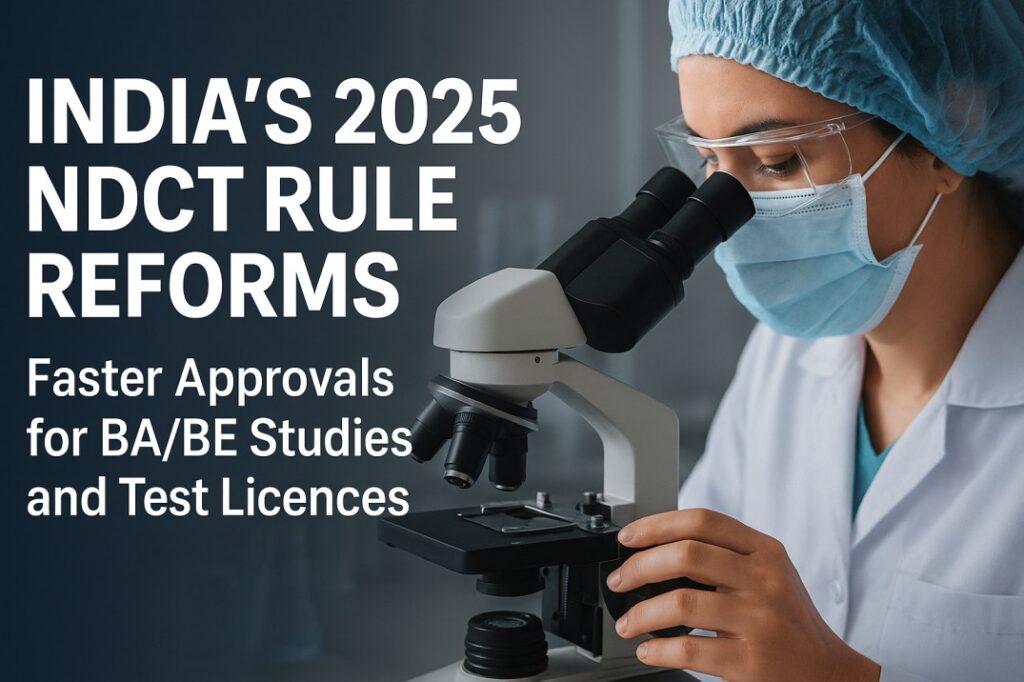

NDCT 2019 Rule Reforms: Accelerating Approvals for BA/BE Studies & Test Licences

India NDCT 2025 reforms are transforming the pharmaceutical industry by enabling faster approvals for BA/BE studies and streamlining test licence processes. These reforms reduce delays in clinical trials, provide quicker access to medicines, and simplify regulatory procedures for companies operating in India’s pharma sector.

In accordance with the directions of Hon’ble Prime Minister Shri Narendra Modi towards reducing the regulatory compliance and towards promoting ease of doing business in the pharmaceutical and clinical research sectors, the Union Health Ministry is set to amend the New Drugs and Clinical Trials (NDCT) Rules, 2019. The proposed amendments were published in the Gazette of India on 28th August, 2025 seeking public comments. The amendments aim to simplify the requirements and procedures for obtaining test licences and for submitting applications related to Bioavailability/Bioequivalence (BA/BE) studies, Key highlights of the proposed amendments are discussed.

India has taken another bold step in accelerate  its pharmaceutical regulatory environment. The Union Health Ministry has recently proposed amendments to the New Drugs and Clinical Trials (NDCT) Rules, 2019, with a strong focus on simplifying approvals for test licences and Bioavailability/Bioequivalence (BA/BE) studies.

This development comes at a time when India is striving to position itself as a global leader in clinical research and generic drug development. By streamlining approval pathways and reducing bureaucracy, these reforms are expected to significantly improve the ease of doing business in the pharmaceutical sector.

In this blog, we will break down the changes, explain their importance, and discuss what they mean for pharmaceutical companies, CROs, regulators, and patients.

NDCT 2019 Rule Reforms: Accelerating Approvals for BA/BE Studies & Test Licences

Background: Why NDCT Rule Amendments Were Needed

India’s NDCT Rules, 2019 were designed to regulate clinical trials, new drugs, and investigational products. While they established a structured framework, many in the industry found the process of obtaining test licences and approvals for BA/BE studies time-consuming and paperwork-heavy.

  • A typical application took 90 days for approval.

  • Every BA/BE study, even those for well-established generics, required a formal licence.

  • This slowed down the pace of clinical research and delayed generic drug development.

Given that BA/BE studies are critical for generic medicines, where safety and efficacy profiles are already known, the old process was seen as unnecessarily rigid. Stakeholders often argued that India needed a faster, risk-proportionate system to match global regulatory practices.

What Are BA/BE Studies and Why Do They Matter?

Before we explore the reform, let’s quickly revisit what BA/BE studies mean.

  • Bioavailability (BA) measures how much of a drug reaches the bloodstream and how quickly.

  • Bioequivalence (BE) compares a generic drug to its reference (innovator) drug to ensure that both work the same way in the body.

In simple terms: BA/BE studies prove that generic medicines are just as safe and effective as their branded counterparts. Without them, patients cannot access affordable alternatives once patents expire.

India is already a hub for generic medicine manufacturing, and faster BA/BE approvals will further strengthen this leadership.

Key Highlights of the Proposed NDCT Rule Amendments (2025)

1. Test Licence Reforms: From Licence to Notification
  • Old System: Applicants had to seek a licence, wait up to 90 days, and could not start until approval was granted.

  • New Proposal: Most applications will only require a notification or intimation to the CDSCO (Central Drugs Standard Control Organization).

  • Exception: Only a small group of high-risk drugs will still need formal licensing.

This means most companies can start their work faster, without waiting months for permission.

2. BA/BE Study Applications Simplified & Accelerated
  • Old System: Every BA/BE study required a full licence application.

  • New Proposal: Many BA/BE studies will only need a simple notification to the regulator.

  • Impact: Saves time, reduces paperwork, and helps companies begin studies quickly.

This initiative underscores the Government of India’s commitment to ongoing regulatory reforms in the pharmaceutical sector. It forms a part of the broader efforts toward Ease of Doing Business to promote the growth of the Indian pharma industry and align domestic regulations with global best practices. These steps are expected to increase attractiveness of India for clinical research thereby strengthening India’s position as a global hub for pharmaceutical research and development.

Leave a Comment

Your email address will not be published. Required fields are marked *

Scroll to Top
Top 7 GCP Rules in Clinical Research