
The Pharmacy Council of India has circulated a draft version of the new B.Pharm syllabus, and the discussion around it has picked up quickly among students, teachers, and industry professionals. The idea behind the revision is straightforward: pharmacy graduates today need to be better prepared for the workplace than the previous curriculum allowed for.
For years, the B.Pharm programme has carried a reputation of being heavy on theory but uneven when it comes to practical skills. Many graduates found themselves in roles that expected them to understand regulatory systems, data-driven decisions, hospital-based patient care, or even modern drug design software, but most of that training had to be learned later, on the job. The proposed syllabus attempts to close this gap.
At the core of the new draft are three noticeable shifts.
First, internships are no longer optional or symbolic. The draft requires two separate internships during the course — one in the industrial or manufacturing side of pharmacy, and another on the clinical or community side. This is a clear attempt to ensure students aren’t seeing their first real workflow only after graduation.
Second, the course encourages research involvement. The final year includes a project spread across two semesters. The intent is to have students handle problems where the solutions are not in the textbook — something that is now essential in both industry and academia.
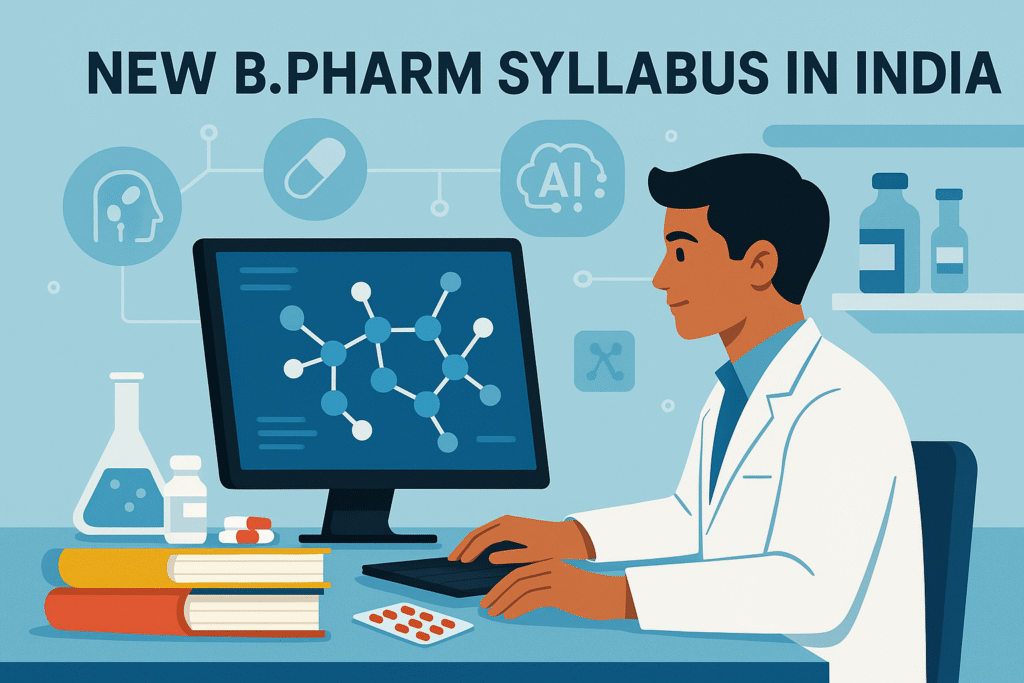
Third, the syllabus makes space for emerging technologies. Terms like artificial intelligence, digital health, computational drug design, and regulatory science are no longer “optional awareness.” They show up in course content, discussions, and practical sessions. This reflects how pharmacy today is deeply tied to software, data interpretation, and interdisciplinary collaboration.
There’s also a renewed emphasis on choice. After the foundational semesters, students are given room to pursue the direction that matches their interests — whether that is manufacturing and quality assurance, or hospital-based practice and patient care. Elective subjects and online learning modules are part of the proposal, which indicates an attempt to break the rigid, one-size-fits-all approach of earlier years.
Of course, there are concerns as well. Some teachers worry that adding advanced, technology-heavy modules will require laboratories and faculty training that many colleges simply don’t have. Students, on the other hand, are more focused on whether these changes will genuinely improve job opportunities — or remain on paper, like reforms often do. The draft tries to answer this by linking skill-based learning and assessment directly to actual working environments, but the effectiveness will only be seen when implementation begins.
In essence, the new B.Pharm syllabus acknowledges a reality that has been visible for a while. The pharmacy profession has moved beyond just compounding medicines and memorising pharmacology classifications. Graduates are now expected to analyse data, understand regulations, communicate with patients, and participate in drug development workflows that cross several disciplines. The proposed curriculum attempts to shape a pharmacist who can handle that.
If implemented properly — with laboratory upgrades, genuine internships, and trained faculty — this syllabus could help young pharmacists enter the field with greater confidence and clearer direction. If not, it risks becoming another document full of possibilities but weak in execution.
For students currently considering B.Pharm, the message is this: the degree is changing. It is becoming more hands-on, more contemporary, and more connected to real work. Those who are prepared to engage actively, rather than rely on rote learning alone, will likely be the ones who benefit from it the most.